Orbit: an AI agent platform for teams, with approvals, budgets and 15+ model providers
Teams set up AI agents with their own model keys, tools, knowledge and budgets, then work with them in chat and on a shared task board. Built for small teams up to companies that need to run it on their own servers.
- model providers
- 15+
- streaming answers per worker
- ~350
- added before the first token (p95)
- 94 ms
What it does
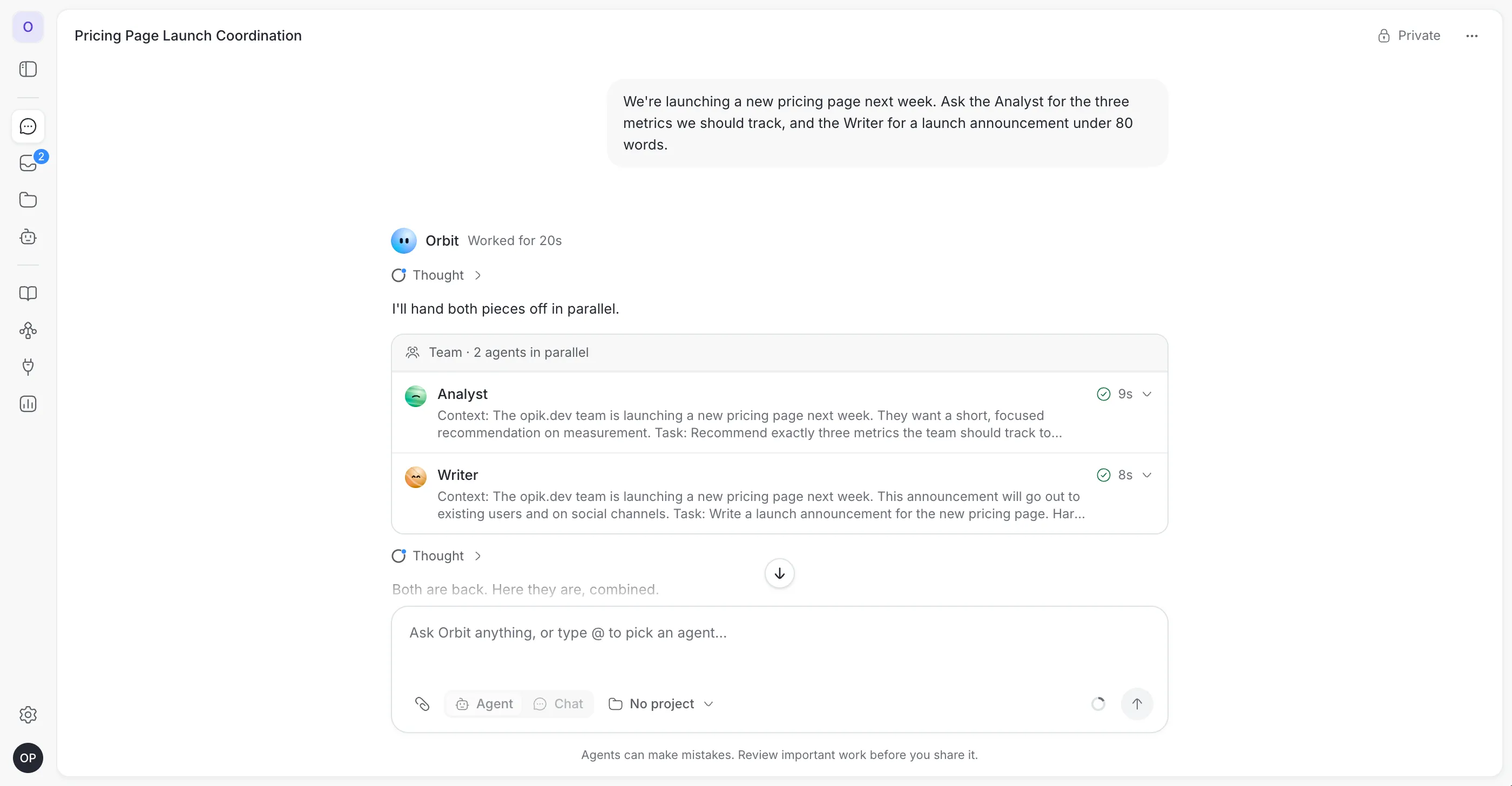
- Chat with an orchestrator that plans the work and hands it to specialist agents in parallel, or @mention a specialist directly.
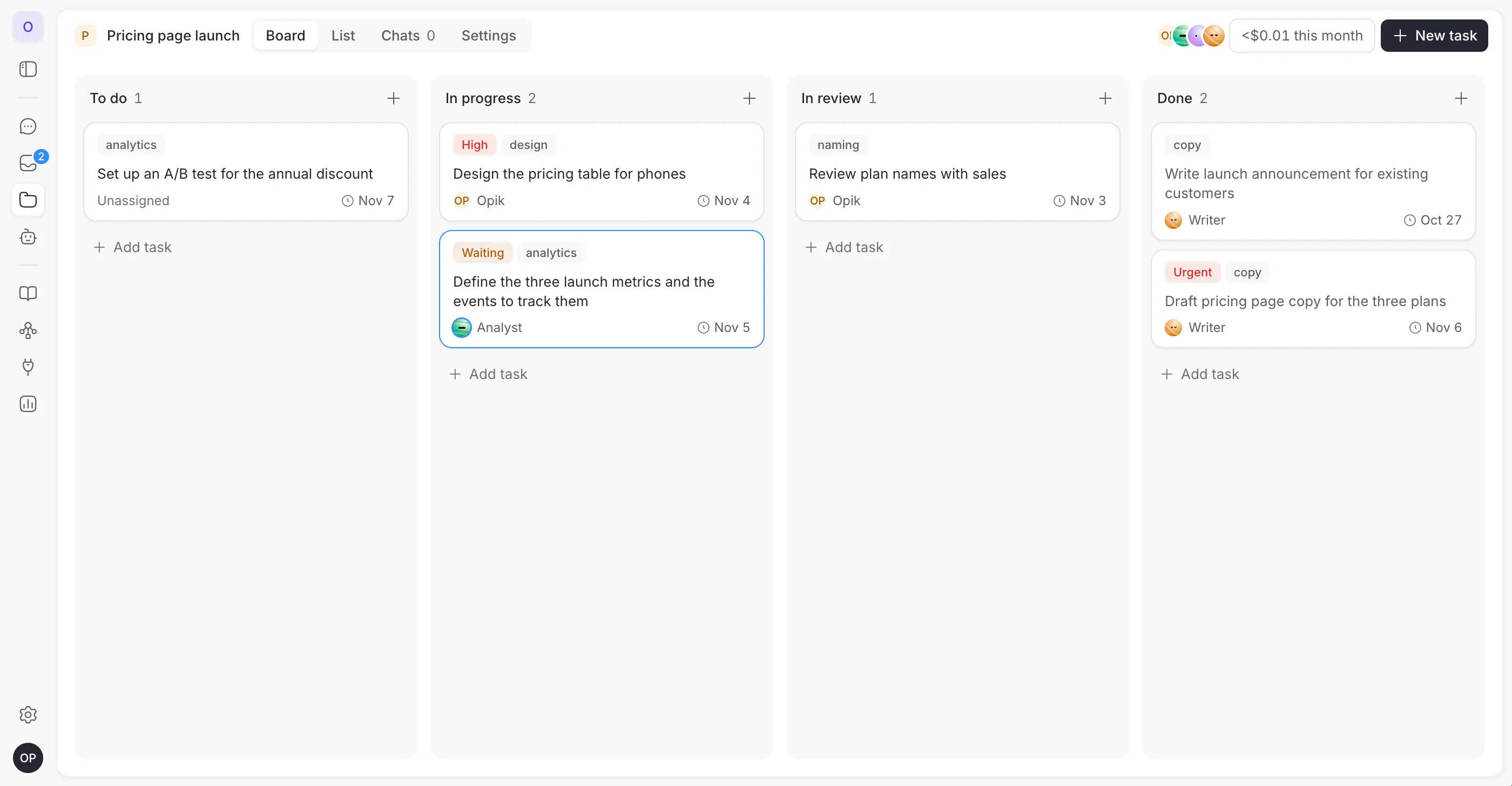
- Assign tasks to agents and people on one project board; agents pick up their tasks and report back.
- Give agents apps through MCP, documents to search and a code sandbox, with each tool set to Ask first, Auto or Never.
- Cap spending per workspace, member, agent or project, and choose whether a spent budget stops runs or only warns.
- Run recurring work on schedules or from a visual workflow builder.
- SSO, SCIM, audit logs, and a self-hosted edition on Docker Compose or Kubernetes.
How it works
The API and workers hold no state, so both scale out on their own. Every change and the run it causes are saved together, so nothing is lost if a worker restarts, and a run that’s waiting on a person holds no worker at all. Live tokens go through Valkey, so any API instance can serve any stream.
Decisions
Agent permissions are checked when a tool runs, not in the prompt
Instead of telling the model what it may do. A prompt can be talked around; a check at execution can’t. Every tool starts at Ask first, so the agent pauses and a person approves it in their Inbox, like the Analyst waiting on the board above. The cost is speed: agents stop more often until a team trusts a tool enough to set it to Auto.
Postgres is the job queue, not Redis
Instead of BullMQ on Redis. A run is queued in the same transaction as the change that causes it, so assigning a task can never leave a lost or duplicate run behind. The cost showed up in the load test: under heavy writes, the queue’s notifications compete for Postgres’s commit lock.
My own run engine on the Vercel AI SDK, not an agent framework
Instead of Mastra or DBOS. An earlier prototype on Mastra could run only one specialist at a time, without tools, and DBOS ties each workflow to the app version that started it, which self-hosted customers couldn’t upgrade around. The cost: runs, retries and resumes are mine to maintain.
Results
- Every feature in the spec built between September 29 and October 15, 2026: 112 commits and 64 database migrations.
- One gate on every change: format, lint, type check, 374 tests and a build, run by Claude Code hooks before a turn could end and again in CI.
- Load test on a laptop, with a mock model so only Orbit’s own time counts: with 150 people chatting, Orbit added 94 ms before the first token at p95, against a 300 ms target. With 120 agent tasks running at the same time, it held 171–214 ms.
- One worker process kept about 350 streaming answers within the latency targets.
Stack
TypeScript · React, TanStack Router and Query, Tailwind · Hono · PostgreSQL with pgvector, Drizzle and pg-boss · Valkey · Vercel AI SDK · Better Auth · Docker and Helm
Work with me
Hiring for work like this? I'm available now for full-time or contract, remote.